Wednesday, 10 April 2019

French certificates


Image result for dipôme


Studying or working in France attracts people from abroad. However, universities or employers in France require a special certificate in order to prove the level of your french. Let's have a look at the various certificates.

Image result for dipôme


DILF, DELF and DALF

They are made to certificate the level of French. They are awarded only by the French Ministry of National Education. They are recognised everywhere. You can follow your studies in France or in another french speaking country or you can get a job. Some universities or some schools require these certificates to be admitted. 


DILF is stand for Diplôme Initial en Langue Française. (Initial Diploma in French Language). This certificate will be awarded to beginners. It is the first step to get DELF and DALF diploma. The level is  A1.1.


DELF is stand for Diplôme d'Etude en Langue Française (Diploma in French Language Studies). Candidates from 7 years old can take this exam. It exists differents options according your needs and your level (A1 to C2). But it declines in several section according your needs:


    Image result for delf
  • DELF PRIM: is for children in primary school (from 7 to 11 years old). This certificate is mostly to encourage children to learn French. It may give to them confidence and self-esteem as well. There are 3 levels: A.1.1 - A.1 - A.2.
  • DELF JUNIOR and DELF SCOLAIRE: These are for teenagers, from 12 to 18 years old, who attends schools. There are 4 levels: A1 - A2 - B1 and B2.
  • DELF PRO: It is for people who wants to get a job in France or in a french speaking country. 4 levels: A1 - A2 - B1 - B2.

DALF is stand for Diplôme Approfondi en Langue Française (Advanced Diploma in French Language). it's the same concept as the Delf. That is different is for candidates who have C1 and C2 level.


And DALFLE is a certification to those who want to teach French abroad or as MFL teacher.


You can prepare them in these places:


  • in a Centre Language appliquée (CLA) in some French cities,
  • in some institutes in UK such as Institutes where they give French lessons,
  •  with a private tutor. This option allows you to personalize courses. 

Le DCL - Diplôme de Compétence en Langue (Language Skills Certificate)

Is awarded by the French Ministry of National Education. This is a professional diploma for adults. If someone wants to make recognised their skill in French language, to get a job or to evolve in his career, this diploma is made for these employment prospects. There are 2 options:
  • DCL FLE for French everyday language, from A2 to C1
  • DCL FP for French professional, from A1- A2.

Level tests

  • TCF - Test de Connaissance du Français (French knowledge test) is awarded by le Centre International d'Etudes Pédagogique. This test is for everyone who wants to validate their knowledge in French fastly and a simply way.
  • TEF - Test d'Evaluation de Français (French Assessment Test). It is awarded by la Chambre du Commerce et d'Industrie Paris Ile de France. This test is also recognised by the National Education. Students who would like to follow their studies in an university in France for the first key stage, can take this certificate.


Image result for diplôme universitaire

Diploma of universities

Students who wish to gain French skills or to improve it, some certicates are offered to them at the University Paris-Sorbonne. Five certificates are proposed and students can achieve all these five certificates in one year if they wish.

Certifications de langue, introduction à la littérature


  • Certificat Intermédiaire de langue française (Intermediate Certificate of French Language) level B1.
  • Certificat de pratique de langue française "Comphréhension et expression" (French language practical certificate "Understanding and Expression") Level  B2.


This certificate is a module. Level B2. This diploma assesses skills in four areas: written and oral comprehension and written and oral expression.
The student can also take either the module "Literature" or the module "French on academic objectives" (FOU) [Humanities and Social Sciences].

Certifications de langue, littérature et civilisation françaises

  • Certificat pratique de langue française (Practical certificate of French language) The level is C1. This certificate with the option "Literature" or with the option FOU "Humanities and Social Sciences" is highly recommended to continue your studies in master and PhD.
  • Diplôme de langue et littérature française (Diploma of French language and literature), level C2. To have access to this diploma, candidates must have previously obtained the C1 level.
  • Diplôme supérieur d'études françaises (Higher Diploma in French Studies), level C3. This diploma is only offered by Sorbonne University. This degree requires the same methodological skills expected of a French student. The admission is conditional.
More informations? 

The professional French diplomas of the CCIP* 

Courses are offered to people who whish to reinforce their French communication skills. It is in the professional setting

TEF ETUDES (TEF studies): is approved by the French ministry of National Education. The candidate is assessed to evaluate his/her French skill. This certificate is for students from abroad who want to study in the first cycle studies of an university in France. The assessment is composed of 4 parts: written comprehension, oral comprehension, written expression and lexicon/structure.

TEF Naturalisation (Tef naturalization) is approved by the Ministry of the Interior of  France. For foreigners wishing to naturalize, it isrequired to obtain this certificate. Candidates will be assessed on both written and oral comprehension. The tests for obtaining this certificate also can be passed to other centres in France approved by the French State. 

Certifications of French approved by the Ministry of the Interior:

TCF - Test de Connaissance du Français (French knowledge test) awarded by le Centre International d'Etudes Pédagogiques (International Center for Pedagogical Studies) and by other centres accross the France: TCF award center

TEF - Test d'Evaluation de Français (French Assessment Test) awarded by la Chambre du Commerce et d'Industrie de Paris et Ile de France (Paris Chamber of Commerce and Industry).

TEF de carte de résident (TEF resident card): For foreigners wishing to obtain the resident's card, this certificate attests the level A2 of oral and written comprehension as well as the level of oral and written expression of the French language. The tests for obtaining this certificate can be passed to other centers in France approved by the French State.


*Paris Chamber of Commerce and Industry: in French, it is  Chambre de Commerce et d’Industrie Paris.


Image result for dipôme


Saturday, 26 January 2019

La recette de la galette des rois


The first Sunday of January, French people celebrate Epiphany day. I have already written an article about this topic https://learningfrenchiseasy.blogspot.com/2016/01/epiphany-in-france.html
They eat a galette and inside it the cooker put a small object which it could bake in the oven without affecting the galette. The person who has the objet (that it's called la fève) in his or her part of galette, he is the King or she is the Queen and someone else puts a paper or cartridge crown on the top of the head.
We can eat the galette all January long.
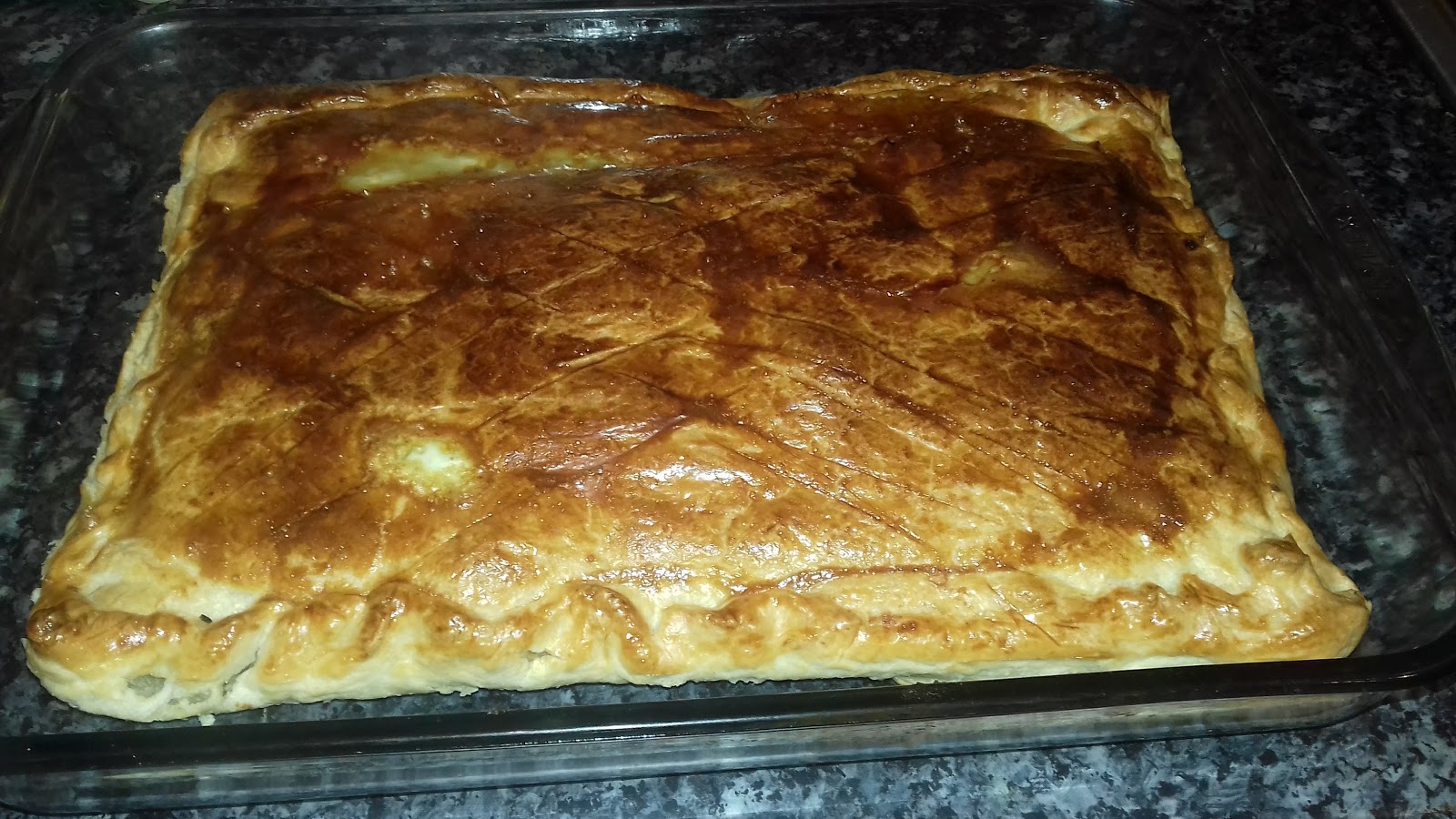
Yesterday I made one. For the recipe, I am inspired from the web site Marmiton.org: https://www.marmiton.org/recettes/recette_galette-des-rois-a-la-creme-frangipane_25062.aspx

I have changed a little bit this recipe to get this galette tastier.

The galette is galette à la frangipane. This is how to make it:

for 8 parts

2 Puff pastries (if you buy the dough already spread, take also 2)
186 g  almond powder
133g caster sugar
3 eggs
100 g butter
1 eggs yolk
one bean non-cooked (facultative)
1 or 2 tsp almond extract (according to your tastes)

Put a first disc of the puff pastry in a pie pan. Pick it with a fork.
In a bowl, mix the powder, the sugar, the eggs and the melt butter (so that to incorporate very well with the mixture). Add the almond extract.
When the mixture is done, pour it on the first disc of the puff pastry and hide the bean inside. Brush the brim of the puff pastries with water.
Put the second disc of puff pastry over of the mixture.
Make some draws and spread egg yolk on it.
Place the galette into the oven during from 20 to 30 min at 200° C (th. 6-7).
Check regulary the cooking.

Enjoy!

I made it rectangular but normally, a galette is round.


Monday, 31 December 2018

It's typically French!!!


Image result for la saint sylvestre en france


Bonjour tout le monde,

Today, it is the last day of 2018. I am sure that some of you, are celebrating New year's day eve. Maybe you are wondering how people in France, celebrate this event.

There are two types of people who celebrate New year's day. Those celebrate the 31st of December on evening and those, the 1st of January.

December of 31 is called the Saint-Sylvestre. This evening, people invites mostly their family or their friends, or both at home. Some prefers to celebrate somewhere else such at clubs, at a restaurant or going to a dancing dinner.
The dinner lasts a long time because there are a lot of meals. Moreover, French like spending their time to eat and talk around a table. Children are less patient and play between two meals.
At midnight, they wish to each other a happy new year and a good health. They use party favors. Children are very happy to play with these. The party can last up to 4 o'clock or more. It is up where you celebrate New year's eve/ New year day. Night clubs'parties can finish at 4:00 am. Then, for those who have still energies, carry on by eating a soup labelled la soupe à l'oignon (onion soup) or warm croissants with coffee or other hot drinks at home.

Image result for fête du nouvel an

On new year's day, French people celebrate this event but it is quieter, less noisy. Some relatives or friends come to wish a happy new year on afternoon. Traditionally, hosts often offer a brioche with a hot drink, or sparkling alcohol drink or champagne. On the evening, guests are off.
In the past, in countrysides, people visited their neighbours or some friends in the village. This tradition is lost now. In the early of 80's, this began to disappear.


Image result for fête du nouvel an


Do you want to know some expressions or word in French? 

Bonne année et bonne santé can be translated by happy new year and have a good health.
Meilleurs voeux can be translated by best wishes.
Le réveillon, la veille du nouvel, can be translated by  new Year's Eve.
Souhaiter la bonne année can be translated by wishing the new year's day.
Les cotillons can be translated by party favors.
Fêter le nouvel an can be translated by celebrating the new year
Faire de nouvelles résolutions (que tu ne tiendras pas.....) can be translated by  making new resolutions (that you will not hold .....) 😂

Image result for bonne année 2019

Tuesday, 25 December 2018

J'aime- je n'aime pas


Do you know how to express when you like or don't like something? There are a lot of way to say if you appreciate or not. Let 's find out!

The basics


Positive sentence: J'aime                   


Sentence with aimer + complement.
Image result for j'aime les fruits
J'aime les fruits. I love fruits.
         complement

Sentence with aimer + Verbe in infinitive.

J'aime manger. I love eating.
           verbe

Sentence with aimer + Verbe in infinitive +complement.

J'aime manger les fruits. I love eating fruits.
             verbe   complement

Negative sentence: Je n'aime pas

Sentence with ne pas aimer + complement.

Je n'aime pas les fruits. I don't love fruits.
                  complement

Sentence with ne pas aimer + Verbe in infinitive.

Je n'aime pas manger. I don't like eating.
                      verbe

Sentence with ne pas aimer +  Verbe in infinitive +complement.  I don't like eating fruits.

Je n'aime pas manger les fruits.
                       verbe   complement


Other expressions to say that you like or dislike.

There are many other expressions to say

J'adore  》 I love, I adore.
Je déteste 》I hate.
Je m'intéresse à 》 I am interested in, I am fond of.
Je ne m'intéresse pas à  》 I am not interested in, I am not fond of.
Je suis fou de  》 I am crazy about.
Je ne suis pas fou de  》 I am not crazy about.
Je suis fan de   》I am a fan of.
Je ne suis pas fan de  》  I am not fan of.

Adding adverbs 

To intensify your feeling, you can add adverbs after j'aime, je n'aime pas : beaucoup, peu, bien, pas du tout....

Il n'aime pas du tout le vélo. He doesn't like riding bike at all.

Les enfants aiment beaucoup le chocolat mais ils aiment peu la soupe. Children like chocolate but they like a bit soup.


Friday, 27 July 2018

At the GPs - Chez le médecin

Image result for centre medical en France


It is summer time and I guess that some of you travel. If you visit a French speaking country, it is good to know some vocabularies.

When we are on holiday, we may be unwell. It is easy to speak with a GP when we are in our country but when it happens abroad and moreover  the language is different, the situation could be difficult. Today, I will teach you some expressions, some words if ever you have to go the GP -le médecin-

First, I will tell you how it works in France.

When you address to a GP, call him or her, Docteur (Doctor).
It is better to get an appointment. When you go, let you know at the receptionist that you are here and give your name, the GP's name where you will see (if there are several ones in this medical center). If you don't see a receptionist, don't worry sit down and wait in the waiting room. The GP will have a look at it. When It is your turn, the GP will tell why you are there. S/he needs to know what do you suffer from. S/he  measures your blood pressure, the heart rate, your weight. Then, s/he auscultates you to diagnose you pain or other. S/he gives to you a prescription. The rate of a consultation is from 25 €.
GP secteur 1 : 25 €
GP secteur 2 : over 25 €

If in your country, it exists an European Health Insurance Card, order it. It can help you at the GP, the hospital, the dentist or the pharmacist.

At the pharmacy, you give the prescription to the pharmacist and will give you the medicine.
Image result for docteur

Vocabularies and expressions

At the GPs: chez le médecin (généraliste)
To get an appointment: prendre un rendez-vous
The medical centre: le cabinet médical/le centre médical/la maison médicale
The waiting room: la salle d'attente
Measuring the blood pressure: mesurer la tension artérielle
Measuring the heart rate: mesurer le rythme cardiaque
The weight: le poids
European Health Insurance Card: carte européenne d'assurance maladie
A prescription: une ordonnance
The pharmacist: le pharnacien, la pharmacienne
The pharmacy: la pharmacie

To greet a GP: Bonjour Docteur !
To thank a GP: Merci Docteur !
To leave a GP: Au revoir Docteur !
Get on the scale: montez sur la balance/ sur le pèse-personne
What are you suffering from: de quoi souffrez-vous
Where is your pain? Oú avez-vous mal ? Oú est la douleur ? Vous avez mal oú ?
I have fever: j'ai de la fièvre
My child has fever: mon enfant a de la fièvre
I have a sore throat: J'ai mal à la gorge
My child has a sore throat: mon enfant a mal à la gorge
I have a headache: J'ai mal à la tête
My child has a headache: mon enfant a mal à la tête
I have a bellyache: J'ai mal au ventre
My child has a bellyache: mon enfant a mal au ventre
I have nausea: j'ai des nausées
I have diarrhea: j'ai la diarrhée
It is twenty-five euros: ça fera vingt cinq euros.

More vocabularies? Please, drop me a comment and I will reply you or join my group Learning French is easy on facebook
https://www.facebook.com/groups/570490083285288/?ref=bookmarks

To go further in your French learning, I give lessons online.

Image result for docteur


Sunday, 27 May 2018

Fete des meres Mother Day


Today, this is Mother Day.

Every year, the last Sunday on May, children (and older!) in France celebrate mother day.

A long process

In ancient times, Mother's Day was born. But it was only for a mother. In ancient history, people believed in many deities. The Greeks celebrated Rhea (the mother of the gods). In France, the birth rate declines at the end of the 19th century.

Since 1866, natalist groups and movements have emerged and encourage birth rates in France. Step by step, the promotion of birth rates is gaining and there are many ideas to encourage the growth of large families.

Then a french teacher, Prosper Roche. He taught in a village which the name is Artas (Isère). On June 10th 1906, he organized a special ceremony for two mothers of nine children. Then, in 1920,  Mother Day concerned only mothers who had several children. This event was officialised in 1929 by the government for all mothers. The target was to encourage natality.

In 1942, Maréchal Pétain, who was at the head of  "le régime de Vichy", encourages the French to celebrate motherhood.

Nowadays

From 1950, Mother Day is celebrated every year, the last Sunday on May. This celebration, then becomes commercial and then replaces the pro-natalist ideals.

At the approach of Mother's Day, or the same day, some town halls hold ceremonies to award medals to mothers of many families.

Children, younger and older, give a present to their mother. At school, pupils make a present. In the past; the necklace noodles was very famous. It was a simple and easy activity for little kids. Year after year, other crafts dethroned it. This present of Mother Day became a symbol.


 The popular present is a bunch of flower. The florists will tell you!
Some children take the initiative to do housework and cooking and tell their mother to have a rest.
This day is the opportunity to gather all the children and a meal is given in honour of Mother day.


Saturday, 19 May 2018

Do not mingle es - est - et


ES EST OR ET?


Can you make the difference between ES EST and ET? 

Although they sound alike, there is a difference between these words. Let ‘s see this difference.


My name is Céline and I help learners in the French language. 


ES 


It comes from the verb to “être” (to be) and it is conjugated by the 2nd singular person: tu. 

For example: Tu es content ?


Be careful! The final letter is mute. 


EST


Est is the verb être (to be) conjugated by the 3rd singular person (ex: il-elle-on) or by someone or something that we talk about. 


Le chat est malade. 

The cat is sick.


If you have a doubt about the spelling, you can swap est by était.

Le chat était malade.


 ET


Et is a conjunction which is used for several functions: to connect 2 words or 2 clauses and to enumerate several things for example. 


Anne et Nathalie mangent un croissant.

Anne and Nathalie are eating a croissant.


Le cuisinier ajoute dans la casserole, du thym, des feuilles de laurier et du poivre.

The chef adds in the saucepan, thyme,  bay leaves and pepper.


Tous les matins, Pierre se lève et prend sa douche.

Every morning, Pierre gets up and has a shower.


Thursday, 19 April 2018

Interjections and onomatopoeia - Les interjections et les onomatopée

Interjections are used to express our emotions: joy, pain, disappointment, astonishment ; to give an order, to call someone. These are short words and come out spontaneously:

Allo !               Hello, hullo
Ah !                 Ha!
Aie !                Ouch!
Allez !             Come on!
Bravo !            Well done! 
Chut !              Shut!
Eh !                 Hey!                                           
Euh !               Haw!
Hourra !          Hurray!
Oust !              Shoo!
Ouf !               Phew!
Ouille !           Ouch!
Oh la la !        Oh Dear!
Oh !                Oh !
Pfff !               Pfff!
Zou !              Shoo!
Zut !               Heck!

Onomatopoeia are used to imitiate sounds:

Bla bla               to end a sentence like etc
Boum                 to imitate something exploding  
Ding dong          to imitate a door bell
Dring                 to imitate a phone bel
Gla gla               to express when you are cold

Glou glou           to imitate water which sink          
Grr                     to express a an anger
Miam miam       to express a good taste
Vlan                   to imitate a slamming door
Vroum                to imitate the noise of a car


Saturday, 24 March 2018

Poisson d'avril!

Poisson d'avril. What does it mean?

On April 1st, above all children make pranks and stick at the back of someone a fish made in paper. When the fish is discovered, the child who sticked the fish say "poisson d'avril!" and it is the same for pranks.

I have never wondered where does it come from this tradition. As I am curious, I made a research about the origin.

We don't know exactly the real story. A lot of versions were told. The most known remains that Charles IX, in 1564, instaured the first day of year was on January 1st instead of on April 1st.  On April 1st everybody used to offer gift each other. The pope Gregoire XIII spread the gregorian calendar to Christian nations in 1582. From January 1st 1565, was the new year day.

Why this day became a foolish day?

Some people met difficulties to remember the new year day and some ignored the reform (No TV, no Internet at that time! 😉). They carried on celebrating the new year day on April 1st. To mock at them, some guys made jokes or hung a fish at the back of their victim. When the fish was found out the jokers shouted "Poisson d'avril"! They also made fake presents.


Why a fish?

Once again, I read different stories. One told that fishing were not allowed due to the reproduction of fish and it was a period which was benefit for fishers. 

The other told that fish is a symbol of the end of fasting (careme). It was forbidden at this period to eat meat for christians. Prankers offered fake fish. the fish was the graphic symbol of Christianism, a sign of recognition. It is made wich two arks. Fish "poisson" would come from the corruption of passion "passion". A corruption is a phonetic transformation of a word.


 A few expressions about fish

Etre comme un poisson dans l'eau (to be like a fish in water): To feel well or to be at your ease in the place where you are or what you do.

Finir en queue de poisson (ending in fishtail): an event or a story which ends roughly and disappointingly.

Faire une queue de poisson (making a fish tail): turning down for a vehicle abruptly in front of the car which it just overtaken.

Noyer le poisson (drowing the fish): muddling up somebody


Avaler la mer et ses poissons (swallowing the sea and the fish inside): to have thirty a lot.

Engueuler quelqu'un comme du poisson pourri (calling somebody every name under the sun): to insult somebody or shouting after someone.


This is the link if you want to print and cut:
https://www.google.co.uk/search?biw=1280&bih=816&tbm=isch&sa=1&ei=ICO-WujgJsSLgAbWz5GgBw&q=poisson+d%27avril&oq=poisson+d&gs_l=psy-ab.1.3.0j0i67k1j0l8.3396.11962.0.17002.21.13.0.0.0.0.2438.3606.7-1j0j1.2.0....0...1c.1.64.psy-ab..19.2.3604....0.zMRwK2D2quQ#imgrc=FsyhoBEXRw_gdM:


Sunday, 4 March 2018

Do not mingle son and sont


Son is a possessif adjective.
Son chat. Her/his cat.
If you have a doubt,  swap son by mon.
Mon chat.
Son is always in front of a noun.

Sont is a verb from être (its infinitive).
Ils sont jumeaux. They are twin.
To know if it is the right spelling, swap this by « étaient » (être conjugated in past tense).
Ils sont à Lyon. Ils étaient à Lyon.

Do you understand ? If you are some questions, don’t  hesitate to drop them in comments.


If ever you want to know more about French Grammar, this book will be useful

http://amzn.to/2DPAkhq


Don't let your child forget French!

Your child was able to benefit from French lessons during the school year. You have seen his progress and he is very proud to know the basic...