Monday, 27 February 2017

recipe of mardi-gras doughnuts (recette des beignets de carnaval)

Tomorrow, it will be Mardi-gras. As I told you in my last article about Mardi-gras traditions, in every household, you can find Mardi-gras doughnuts. If you want to taste them, I am giving to you the recipe. 

For about 40 doughnuts

Ingredients

   500g flour (500g de farine)

  100g melted butter, 90 g sugar (100g de beurre fondu,90 g de sucre)


  3 eggs, 5tsp fresh creme, 1 pinch of salt (3 oeufs, 5 cuillères à café de crème fraîche, une pincée de sel)


  1packet of baking powder (= 15g), 1 tsp orange-flower water (1 paquet de levure chimique, 1 cuillère à café d'eau de fleur d'oranger)

1 lemon peel (1 zeste de citron)


Iced sugar (made by myself) (sucre glace, fait par moi-même)

Preparation

  
Mix all ingredients in a big bowl.
Mélangez tous les ingrédients dans un saladier.


Knead well the pastry to get it smooth. 
Pétrissez bien la pâte pour la rendre lisse.
 
Leave the pastry during one hour at room temperature.
Laissez la pâte pendant une heure à température ambiante.
 
One hour later, spread it very thinly.
Une heure plus tard, étalez-la très finement.

 
Cut up the pastry making a shape: for example rectangle, triangle, circle, star, etc. My tips: Do a notch inside the doughnuts.
Découpez la pâte en faisant une forme : par exemple en rectangle, en triangle, en cercle, en étoile. Mes conseils : faites une entaille à l'intérieur des beignets.

Make the doughnuts frying in hot oil.
Faites frire les beignets dans de l'huile chaude. 

 
When fried, sprinkle them with iced sugar.
Quand ils sont cuits, saupoudrez de sucre glace.

Enjoy!


Monday, 20 February 2017

Mardi-gras event


Sorry! it is a long time that I haven't written something. But I am so busy! I have a bit of time to tell you how french people celebrated Mardi-gras event until the end of the eighties.

Mardi-gras (or carnival day) is the Lent's Eve, everybody knows that! For children, it was a very important day. After school, we disguised in our favorite hero, in princess, in an animal and so on. Ready, we went out with our brothers, sisters and friends in the streets of our village and knocked out the doors. People opened the door and tried to recognize who was behind each mask. Some did that when they know children in the village. After, they gave us coins, treats, mardi-gras doughnuts. We were very happy with our full of treats bag!  Somebody welcomed children very warmly but some weren't happy to see us. So, we knew where to knock out. We enjoyed a lot. When the night come, we went home and showed to our mum what we collected. My mother didn't want us to eat to much sweets. It was a good reminder.

These are our heroes mask that we wore for Mardi-gras event
 In these masks, it wasn't comfortable because we were hot and some difficulties to respire (although there were two holes to breath). Every 5 minutes, we had to take it off, to have fresh air but we enjoyed all the same!

Nowadays, the sweets collection does not exist. No children disguised in the street. But I am sure they enjoy eating good Mardi-gras doughnuts.
YES! Because when Mardi-gras comes, French people cook doughnuts with a variety of shapes: rectangle, circle, triangle, lozenge... You can buy them at the bakeries too. When it was time to cook them, I enjoyed with my mum, my sisters and my brother to make them.


There is another event in relationship with Mardi-gras that many cities or towns in France organize. It is the carnival. You can see some people disguised on the carnival floats or escorting them, wandering in the streets accompanied by the music. It is very colourful, exciting. You are sure to have a good time!


Friday, 4 November 2016

Quel temps fait-il en France ?


Image result for météo


What's the weather like? It is a sentence that we ask at least once a day. This expression is used to know what to wear, if you can do activities outside or just to speak about the weather allows to start a conversation. If you wish to talk about the rain or the good weather, you are on the good page.

Quel temps fait-il?

a few of vocabulary

Image result for météoThe clouds: les nuages
The sun: le soleil
The rain: la pluie
The storm: l'orage
The flash: l'éclair
The snow: la neige
The flake: le flocon
The black ice: le verglas
The wind: le vent
The fog: le brouillard
The weather report: la météo
The Rainbow: l'arc-en-ciel.

Some expressions
Image result for le soleil brille
It is sunny: il fait soleil (ou il fait beau).
It is raining: il pleut ( familiar expression: Il fait un temps de chien!).
It is a poor weather: il fait mauvais (temps).
It is hot: il fait chaud.
It is cold: il fait froid ( familiar expression: ça caille !).
It is frozen: c'est gelé.
It is foggy: il y a du brouillard.
It is snowing: il neige.
There is black ice: il y a du verglas.
The sky is blue: le ciel est bleu.
The sky is grey: le ciel est gris.

Parler de la pluie et du beau temps means to talk about usual things of life.


Wednesday, 3 August 2016

Days of week, month, seasons


Image result for weekdays in french


Les mois   -  Months
January - February -  March - April - May - June
  July - August - September - October - November - December

Les saisons  -   Seasons

Image result for paysage de printemps
Printemps

Image result for paysage d'été France
Eté


Image result for paysage d'hiver
Hiver


Automne


Thursday, 14 July 2016

The short and long versions of the French National anthem


"La Marseillaise" is the National anthem that French people sings for national events like the national day, on the 11th of November and other occasions like in sport events for example. It was written by Claude Joseph Rouget de Lisle in 1792 in Strasbourg.  This author wrote the six first verses. The totality of the verses counts 15.

First, the name of the song was a war song and and named "Le chant de guerre pour l'armée du Rhin". it was for the French army. The circumstances of the revolution made change the name of this song. The National Guard of Marseille (a city in the south-east of France) appropriated the song and the title changes again and called "Chant de guerre des armées aux frontières". The people of Marseille went to Paris to help the revolutionnaries singing this song. People from Paris said it is the song of the people of Marseille. That became the name of "la Marseillaise".

The short version is always sung with the first verse with the refrain for most events.


The long version is not sung very often.


Wednesday, 13 July 2016

The National Day in France

Image result for activités du 14 juillet


Tomorrow, France is celebrating its famous national day or "le 14 juillet day". But do you know what are the origins? What do French do this day?

It began this way....

In 1789, the revolution started. Before that, the crises were everywhere: French people starved, havests were particulary bad, the unemployment increased, the state was financially ruined because they helped United States for their independance and it costed them a amount of money. Burgess wanted to share the equality with the nobility. During this time, the king Louis the XVIth didn't do anything. Deputies proposed to remove the absolute monarchy and to set a constitution. The king, of course, didn't agree. So the deputies of the "tiers d'état" (the third estate: it represents the great majority of people in France, it was composed of workers, landowner peasants, artisans, burgess) refused to split each other without changing the French government: it is '"le serment du jeu de paume" established the 20th of June 1989. Finally, the French monarque had to bow down. So, the deputies are allowed to write the constitution.The first National Assembly is born under the name of "l'assemblée constituante". But later, he regreated doing it.

What was going on? You know?

Image result for la révolution française
La Bastille
We could imagine that king was irate so he decided to dismiss the Assembly. The deputies reacted and call for artisans and burgess to defend them. As the last one had no weapons, they decided to take some in a prison called "la Bastille". On the 14th of July, they attacked this prison and the event is "la prise de la Bastille". From this date, every year French people celebrate this event. After that, the Declaration of the Human rights and Citizen was proclaimed on the 26th of August 1789.

The celebration

It is bank holiday and the day is special.
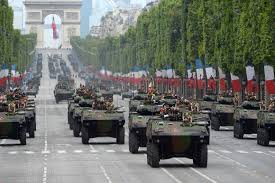
Image result for feu du 14 juillet paris
In the morning, there is a military parade at "les Champs Elysées". Every year, the president invites a guest star, for example, it could be a squadron from abroad. All military Unit are represented : Unity on foot, Unity on horse,  motorized and mechanized Unity and air Unit. This parade has been setting since 1790.

In every city, villages, the mayor, his/her councillors and some people living in the municipality go to the war memorial to lay a wreath. I remember when I was a child, I saw someone reading a list which were written the names of soldiers who died in wars (from the first world war and the followings) and for each name someone else said "death to France". The National anthem was sung. In Paris, in addition to lay a wreath at the war memorial, the President lays another one to the unknown soldier.

On afternoon, people have fun playing games (adults and children), for example they must guess how much does a big piece of ham weight. If someone is close to the right weight, this person wins it, the race stilts... They eat and drink. It is a good time to share. Meanwhile, the President gives a garden party at the Elysée. He invites famous and anonymous people.

On evening, everybody waits for the night to see the famous fireworks particulary children who are very impatient. It lasts about one hour. In general, it is free. After, some of them go to the dancing. It is organized by the municipality or by association, firemen...

This day is really a busy day even if it is bank holiday. Most of French love the National day.

Image result for feu du 14 juillet paris

Don't let your child forget French!

Your child was able to benefit from French lessons during the school year. You have seen his progress and he is very proud to know the basic...