Sunday, 31 January 2016

verbs "avoir" (to have) and "être" (to be)


 Image result for avoir  être


What about to learn how to use and conjugate the verbs "avoir" (to have) and "être" (to be)?

Ok? Let's go!

These verbs are very important because we use them all the time.

The verb "être"

It is employed to describe:
- a state: cette voiture est accidentée
              This car is crashed
- someone: elle est intelligente
                  she is clever
- something: cette machine est facile à utiliser
                    this machine is easy to use
- a mood: Pierre est fatigué
                Pierre is tired
- passive tense: le jardin est couvert de fleurs.
                        the garden is covered with flowers

How to conjugate it?
Image result for expression avec être
Je suis
Tu es
Il/Elle est 
Nous sommes
Vous êtes
Ils/Elles sont

The verb "avoir"

This verb is used to describe:
- someone physically: Marie a les yeux verts 
                                 Mary has green eyes
- to possess something: mon voisin a une belle villa
                                     my neighbours has got a nice villa
- to use the perfect tense: j'ai acheté ce livre.
                                       I have bought this book.

How to conjugate it?
Image result for verbe avoir

J'ai
Tu as
Il/Elle a
Nous avons
Vous avez
Ils/Elles ont


Saturday, 9 January 2016

Epiphany in France

               
On January 3rd, it was Epiphany day in France. Every year, people celebrate this event. How do they celebrate it ? What is the origin of this celebration ?

History of epiphany

It was a pagan celebration. Romans made this celebration up in the name of Saturnales, it lasted 7days. Soldiers drew lot, with a bean, a death row inmate. This one became a king and at the end of the Saturnales, he was executed. A young soldier was elected to be a king and could execute whoever he wanted. The master and a slave exchanged their role during this time. 


The 4th century, Christians adopted this feast and began to honor the Magi, the second Sunday after Christmas. In 1875, they replaced the bean by a porcelain figurine in cakes. 

Nowadays

In France, the famous galette des rois is eaten for this event. The Epiphany takes place the first Sunday of January. It exists a variety of galettes. But the most famous is the one made with puff pastry and filled with almond powder and inside there is the figurine that French people label la fève.The real tradition is that the youngest of the family sits under the table and tells which portion of the galette will be for someone. The person who finds the figurine, will have the crown, is the king or the queen and chooses her king or his queen.
 

The Epiphany day also marks the end of the greeting season. People takes Christmas decoration and Christmas tree off.

Different galette des rois

you could find a lot of  varieties of these galettes, but the most bought are:


- brioches
- frangipane galettes
- apple galettes

I can't complete this article without speaking to you of the galette des rois from Franche-Comté, my native shire. It is a galette which was created in XIV th century. It is made with choux pastry (pâte à choux) and with a bit of orange blossom liquid. Obviously, you insert a figurine inside it.


Thursday, 24 December 2015

Childhood memories at Christmas time


Today, it will be a more personal post, I am going to tell about my childhood at Christmas time. My sibling and I were waiting for this event with impatience. Christmas was always on holidays. At this time, it was a real winter, it snowed a lot. With my friends and my cousins, we shifted the snowy slodes, do batlles of snow or made snowmen. When we came at home, we were very wet but very happy.

The day before Christmas, we were very excited thinking of the celebration and receiving presents. When the night came, after the Christmas mass, our  guests (our relatives) came and ate with us. It was a really good ambience. My uncles and my faher sang, told some comic stories. They also disguised made short sketches. It was so funny! The diner was traditional: toasts of sturgeon eggs, toasts of butter prawns,  turkeys with chestnuts,  and the best of the diner: the Christmas roller.

When midnight approached, my father and my uncles  took all children with them to have a round by car. Inside the car, we sang Christmas songs. Meanwhile, my mother and my aunts put presents down the Christmas tree. When we came back at home, my mother said that Santa visited the house and gave gifts. We believed that. We were very pleased to remove the paper to discover our presents. We said thank you and wished a merry Christmas to grown-ups.  We played with our new toys until the sleep came carry us. The 25 of december, it is another lunch with family but it was quieter.

A week later, we renewed the celebration for the new year's day but without presents. We also enjoyed. Thebfirst day of the new year, some people in the village or some relatives visited  us to wish a new year's day or we visited them. But this tradition is over, it is just relatives who come to visit.

Tuesday, 22 December 2015

French Christmas tradition


Résultat de recherche d'images pour "noel"

It is Christmas time and I take the opportunity to talk about the French traditions of Christmas.

At Christmas time

Public places

Résultat de recherche d'images pour "Marché de noel"Almost one month before, people are already bathed in the Christmas mood. Streets are alighted by Christmas lights and Christmas trees takes place on main places. You can hear Christmas songs and New Year's songs. Christmas market take place in cities. There are some famous such as Strasbourg, Montbéliard, Amiens, Reims, Avignon, Lyon, Marseille and Paris in the "Champs Elysée". When you pass stores, shop windows are decorated and inside too.

Houses

People decorate the interior of their house and fir. They set the crib. Outside, they also decorate their house with light trings.

The celebration of Christmas

 At Christmas eve, children put their shoes under the Christmas tree waiting for midnight. They hope to meet  le "Père Noël" who will fill shoes of gifts and chocolates. In the past, children had only an orange as presents. The hosts dress a nice table with decorations and confectioneries. At the beginning of the evening, people go to the church and after they have a diner. At midnight, they wish to each other a happy Christmas and offer presents. About children, either they go to bed if they are very young and will find out their gifts the morning of Christmas or /and for older kids, they receive their presents at midnight. At Christmas day, a big lunch is also given.


What do french people eat traditionally ?

Traditionally, French people eat at this celebration and at new year day diners these meals :

Starter


The foie gras is made with a goose's liver. Most of people love eating it.


                              Seafoods eaten with the mayonnaise, it is very good.


Oysters with a juice of lemon gives a good taste. Lot of people love that.


Résultat de recherche d'images pour "coquille st jacques"

                                                                          Coquilles saint-Jacques


Snails is a famous meal in France. There are a lot of recepe from snails. When they are presented with their shell, we use a spoon-like forceps in odrer to extract easily the snails.


Main dishes

Turkey with chestnuts,


Résultat de recherche d'images pour "magret de canard image"Duck breast (Magret de canard)


Desserts

Roller of Christmas

Two types: pastry roller of Christmas that made with sponge cake and butter cream and the second option it is the iced roller of Christmas.


confectioneries

Children and as well grown-ups like to taste chocolate or fruit pastes or nuts.
The most popular are "les papillotes" that are made with chocolate or fruit pastes wrapped in glossy paper. But you can find "marrons glacés" (iced chestnuts). They are cooked chestnuts that were macerated in a sirup during several hours. Chocolate truffles and shortbreads are very appreciated too.


Résultat de recherche d'images pour "papillotes et marrons glacés"
    Résultat de recherche d'images pour "friandises de noel au chocolat"


Résultat de recherche d'images pour "papillotes et marrons glacés" 

There is so much dishes that i can't dress a long list.

Monday, 2 November 2015

Education (part two)


Résultat de recherche d'images pour "le jours et les horaires d'école"


Schools has changed a lot since Jules Ferrie's reform. Pre-school and primary school were accessible to everyone. But beyond, only rich people could send their children to secondary school, grammar high school and university. Now, whatever the social class, these schools are opened, however some schools remain elitist due to the expensive fees.

School today

The school landscape has changed. All French schools are mixed and girls'education was very encouraged. Moreover, they are no longer confined to learning to so-called female occupations (cooking, sewing, housework, childcare) but access to other trades has widened. Moreover, education has indeed democratized.

The french education system

Schooling starts at 3 years but it is compulsory to the age of 6 years up to 16 years. In general, the child remains three years in kindergarten (or four years if he began his schooling at 2 years).
Then he continued his learning at the primary school for five years.
It connects with the secondary school. He stayed four years.
Then the student returns to grammar high school to remain there three years. Some go to the general high school and vocational school others will. At the end of his studies, he spent his A'level, precious document, for higher education.
Finally, the student completes his studies in either a faculty or in a University Institute of Technology, or in a high school to prepare a Higher Technological Baccalaureate.

Academic Education division

France is divided into academy, we have 26 and each one is led by the rector. These are grouped into three areas from 1964-1965 (zone A, zone B, zone C). This helps to better manage departures and holiday returns, but also to promote tourist activities. However, students have their school holidays all at the same time as the Christmas holidays and summer vacation.

School holidays

From kindergarten to high school, students say 4 holiday periods school holidays lasting 15 days and major holidays or summer vacation that count eight weeks vacation, extending early July to early September.

School days

Pupils in kindergarten and primary school are in school every day except Saturday and Sunday. On Wednesday, students only make it in the morning.


L'école d'aujourd'hui

Le paysage scolaire a changé. Toutes les écoles françaises sont mixtes et l'éducation des filles a été très encouragée. De plus, elles ne sont plus cantonnées à apprentissage vers des métiers dites féminins (cuisine, couture, travaux ménagers, puériculture), l'accès à d'autres métiers s'est élargi. De plus, l'enseignement s'est bel et bien démocratisé.

Le système éducatif français

La scolarisation commence à partir de 3 ans mais elle est obligatoire à l'âge de 6 ans jusqu'à 16 ans. D'une manière générale, l'enfant reste 3 années à l'école maternelle (ou 4 année si celui-ci débute sa scolarisation à 2 ans).
Ensuite il poursuit son apprentissage à l'école primaire pendant 5 ans.
Il enchaîne avec le collège. Il y reste 4 ans.
Puis l'élève rentre au lycée pour y demeurer 3 ans. Certains vont au lycée général et d'autres vont au lycée professionnel. A la fin de son cursus, il passe son baccalauréat, précieux sésame, pour les études supérieures.
Enfin, l'étudiant termine ses études soit dans une faculté, soit dans un Institut Universitaire Technologique, soit dans un lycée pour y préparer un Baccalauréat Technologique Supérieur.

Découpage académique

La France est découpée en académie, on en compte 26 et chacune est dirigée par le recteur. Celles-ci sont regroupées en 3 zones depuis 1964-1965 (zone A, zone B, zone C). Cela permet de gérer au mieux les départs et les retours de vacances, mais aussi pour favoriser les activités touristiques. Cependant, les élèves ont leurs vacances scolaires tous en même temps comme les vacances de Noël et les vacances d'été.

Les vacances scolaires

De la maternelle jusqu'au lycée, les élèves ont 4 périodes de vacances dites vacances scolaires qui durent 15 jours et les grandes vacances ou vacances d'été qui comptent 8 semaines de vacances, s'étendant au début de juillet jusqu'au début de septembre.

Les jours d'école

Les élèves des écoles maternelles et primaires vont à l'école tous les jours sauf le samedi et le dimanche. Le mercredi, les élèves s'y rendent seulement le matin.

Sunday, 4 October 2015

Education (part one)


Image result for l'ecole en france noir et blanc


Schools start at 3 years-old and the legal age to stop the scholarship is 16 years-old. But rare are teenagers who stop at this age. They follow as later as possible.

History of education in France


First schools already existed in the time of Gaul. It was druids who taught to sons of nobles. Prima magisters gave lessons at municipal schools, the first secular schools were born when Romans conquered Gaul by Jules César in 58-51 bef. JC. They welcomed girls and boys from 7 to 12 years old coming from middle class.
At Vth and VIth century, Church took over, parochial schools managing by priests and monastics schools which the education was specific in order to train novices by monks.

Something new happened about education with Charlemagne end of VIIth century. The organization of school and pedagogy pushed themselves forward. Charlemagne ordered that priests are responsible for schools in small towns, that they teaches to all children of faithful and to settle for the present of children's parents. No services will be asked in return.Grammar, songs and psalms must be taught in all the monasteries and bishoprics.
Charlemagne invented school which the name is the "Palace" in all his travels. He deals with teacher training.
In the XIIth century, a massive school enrollment appears.The bourgeoisie understands the value of education. She used to train business people to be more effective.
In the mid XVth century, the school is once again in turmoil caused by the Hundred Years War and the Black Death.

Primary school reappeared in the XVIth century by Church. Martin Luther, a reformist monk, allows to girls to access to the knowledge.

Napoleon Bonaparte created high schools.

Early 19th century, only rich families sent their children at school because they had to pay teachers, books. For some children, they had to work in order to bring a salary for the home, instead of going to school.
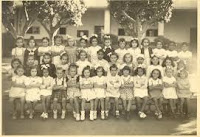
When Jules Ferry was minister, he decided that all public schools should be mandatory and free. In 1833, a
law obliged each village and cities to open a school for all children. In the cities, there were one school for boys, one school for girls.


L'école existait déjà du temps des Gaulois.C'était les Druides qui enseignaient aux fils des nobles. Les écoles communales, les premières écoles laïques, dont les cours étaient assurés par les Prima magisters, ont vu le jour lorsque les romains ont conquis la Gaule par Jules César en 58-51 av JC. Elles accueillaient des filles et des garçons de 7 à 12 ans issus des classes moyennes.
Au Vème et VIème siècle, l'Eglise reprend le flambeau, les écoles paroissiales tenues par les curés et par l'école monastique dont l'enseignement est plus spécialisé. Il s'agit là de former des novices. Ce sont les moines qui en ont la charge.
On assiste à un renouveau dans le domaine de l'enseignement avec Charlemagne fin VIIème siècle. L'organisation de l'école et la pédagogie se mettent en avant. Charlemagne ordonne que les prêtres soient responsables des écoles dans les bourgs, qu'ils enseignent à tous les enfants des fidèles et qu'ils se contentent ce que leur offrent les parents. Aucun service ne sera demandé en contrepartie. La grammaire, les chants et psaumes doivent être enseignés dans tous les monastères et les évêchés. Charlemagne a inventé l'école du Palais qui le suit dans tous ses voyages. Il s'occupe de la formation des maîtres.
Au XIIème siècle, une scolarisation massive apparaît. La bourgeoisie comprend l'intérêt de l'enseignement. Elle sert à former les hommes d'affaire pour qu'ils soient plus performants.
Au milieu du XVè siècle, l'école se retrouve à nouveau dans la tourmente causées par la guerre de cent ans et la peste noire.
L'école primaire est réapparue au XVIe siècle par l'église. Martin Luther, un moine réformateur, permet aux filles d'accéder à la connaissance.
Napoléon Bonaparte a créé le lycée.
Début du 19e siècle, seules les familles riches envoyaient leurs enfants à l'école parce qu'ils devaient payer les enseignants et les livres. Pour certains enfants, ils devaient travailler afin d'apporter un salaire pour la maison, au lieu d'aller à l'école.
Lorsque Jules Ferry était ministre, il a décidé que toutes les écoles publiques devraient être obligatoires et gratuites. En 1833, une loi oblige chaque village et les villes d'ouvrir une école pour tous les enfants. Dans les villes, il y avait une école pour les garçons, une école pour les filles.


http://www.gb-provence.com/ecole_historique.htm
http://www.etab.ac-caen.fr/ecolespubliques.cantonbricquebec/2010/sottevast/pages/ecole.html
https://fr.wikipedia.org/wiki/%C3%89cole

Don't let your child forget French!

Your child was able to benefit from French lessons during the school year. You have seen his progress and he is very proud to know the basic...